
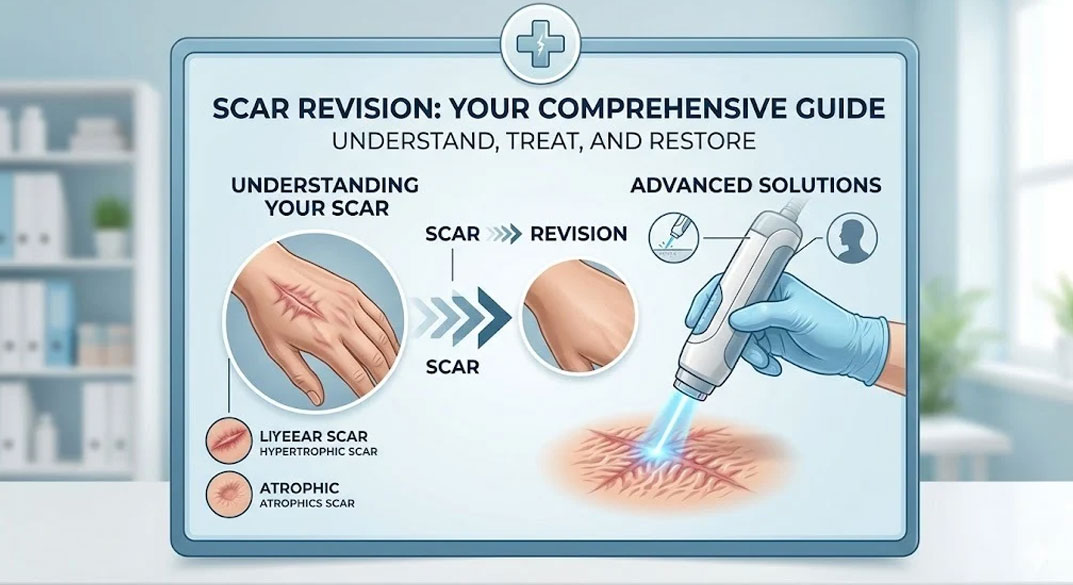
Scars are a natural part of how the human body heals after injury, surgery, or illness. While most scars fade gradually over time, some remain prominent, raised, discoloured, or functionally restrictive — affecting not just appearance but comfort and confidence. For patients in Navi Mumbai and the wider Mumbai region, scar removal treatment and scar revision surgery offer a structured, evidence-based pathway to improving these concerns.
This guide provides an educational overview of scar types, scar revision treatment options, and the factors that influence treatment selection — based on the specialised expertise in plastic, reconstructive, and aesthetic surgery available at the clinic of Dr. Sanket Ekhande (MBBS, MS, M.Ch — Plastic Surgery), Consultant Plastic & Aesthetic Surgeon at Unique Aesthetic Clinic, Vashi, Navi Mumbai.
Scar removal treatment — more accurately described as scar revision — refers to a range of surgical and non-surgical procedures designed to improve the appearance, texture, or functional impact of a scar. The goal is not to erase a scar entirely (which is biologically impossible) but to make it less noticeable, more uniform with the surrounding skin, and less likely to cause discomfort or restrict movement.
Scar revision may be considered a cosmetic procedure when the primary concern is appearance, or a reconstructive procedure when the scar restricts movement, causes pain, or follows trauma, burns, or complex surgery. In practice, many cases involve both dimensions simultaneously.
When the skin is disrupted — whether by a cut, burn, surgical incision, acne, or trauma — the body initiates a wound-healing cascade. This process involves three overlapping phases:
Factors that influence how a scar forms include the depth and location of the wound, the patient's age, skin type, genetic predisposition, infection during healing, sun exposure, and the quality of initial wound care.
Acne scars develop when inflammatory acne lesions damage the deeper layers of the skin. They present in several forms, including rolling scars (broad depressions with sloping edges), boxcar scars (sharply defined depressions), and icepick scars (deep, narrow pitted channels). Acne scar treatment in Navi Mumbai commonly involves laser resurfacing, microneedling with PRP, subcision, or dermal fillers, depending on the scar subtype.
Following any operation — from a cesarean section to organ surgery — an incision scar remains. Surgical scar revision may be considered when the scar is wide, elevated, poorly positioned, or has healed with visible irregularities. In many cases, a plastic surgeon can revise the incision line to produce a finer, better-oriented scar.
Injuries from road accidents, falls, animal bites, or lacerations often produce irregular scars — shaped by the mechanism and direction of trauma rather than a planned incision. Traumatic scar correction typically involves excision of the scar tissue and re-closure under lower tension, sometimes using geometric techniques such as Z-plasty or W-plasty to redistribute scar lines.
Burns affecting deeper skin layers frequently result in significant scarring and, in more severe cases, contractures — bands of tight scar tissue that restrict joint movement. Burn scar treatment in Navi Mumbai may involve a combination of pressure therapy, silicone products, skin grafting, flap reconstruction, and contracture release procedures. Dr. Ekhande's practice includes post-burn deformity correction as a dedicated service area.
Both keloids and hypertrophic scars are characterised by excessive collagen deposition during healing, but they behave differently:
| Feature | Hypertrophic Scar | Keloid Scar |
| Boundaries | Stays within wound margins | Grows beyond wound margins |
| Growth | May reduce over time | Can continue to enlarge |
| Recurrence | Lower risk after treatment | Higher tendency to recur |
| Symptoms | Mild itching/firmness | Itching, pain, tenderness |
| Common sites | Chest, shoulder, knee | Earlobes, chest, upper back |
| Treatment approach | Surgical, laser, steroid | Multi-modal, often combined |
Keloid removal in Navi Mumbai is most effective when managed by a plastic surgeon who can combine surgical excision with adjunctive measures — corticosteroid injections, pressure therapy, or radiation therapy — to reduce the likelihood of regrowth.
Not every scar requires intervention, and many improve substantially with time and conservative care. Consulting a plastic surgeon is reasonable if:
A scar that is still in the active maturation phase — typically pink, raised, or changing in texture — may benefit from conservative measures first, with surgical revision reassessed later.
The range of scar correction procedures available can be broadly divided into non-surgical and surgical approaches. In many cases, a combination of both is used across different stages of management.
| Treatment | How It Works | Best Suited For |
| Silicone gel / sheets | Occlusion and hydration that modulate collagen | Hypertrophic scars, early keloids |
| Corticosteroid injections | Reduce collagen overproduction, flatten scar | Keloids, raised hypertrophic scars |
| Laser resurfacing / ablative laser | Remove surface scar tissue, stimulate collagen remodelling | Acne scars, surgical scars, uneven texture |
| Microneedling with PRP | Micro-injuries trigger collagen; PRP growth factors support repair | Rolling acne scars, mild textural scars |
| Dermal fillers | Temporarily fill depressed scars to create a smoother surface | Atrophic / depressed acne scars |
| Chemical peels | Controlled exfoliation to improve surface texture and pigmentation | Superficial acne scars, post-acne marks |
| Pressure therapy / garments | Continuous compression that flattens and softens scar tissue | Burn scars, hypertrophic scars |
| Procedure | Description | Indication |
| Simple excision & re-closure | Scar is removed and wound re-closed under minimal tension | Wide or poorly healed scars |
| Z-plasty / W-plasty | Geometric rearrangement of scar to reorient, lengthen, or break up the scar line | Linear contractures, straight scars crossing tension lines |
| Subcision | Needle-based technique to release fibrous tethering beneath depressed scars | Rolling acne scars, tethered scars |
| Skin grafting | Donor skin used to replace scar tissue over large areas | Extensive burn scars, post-excision defects |
| Flap reconstruction | Local or distant tissue rearranged to cover scarred area | Complex defects where skin grafts alone are insufficient |
| Contracture release | Scar band is released surgically to restore joint mobility | Burn contractures over joints |
| Tissue expansion | Gradual stretching of adjacent skin to cover scar area | Scalp and larger body area scars |
For patients with keloids, surgical excision is typically combined with adjunctive therapies (corticosteroid injections, radiation, or pressure) to reduce recurrence risk, as excision alone carries a higher risk of regrowth.
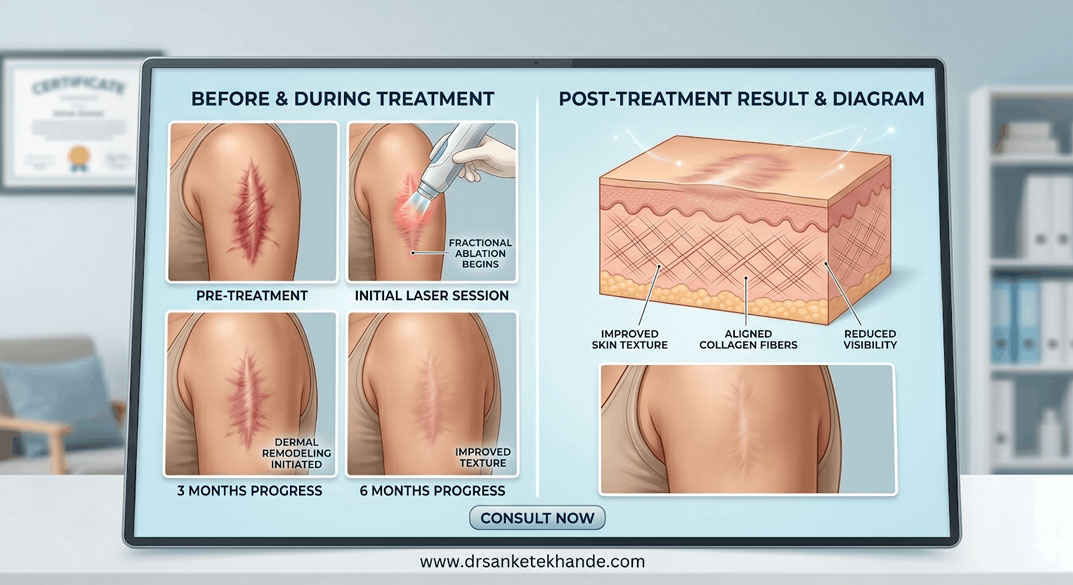
There is no single approach that is appropriate for every scar or every patient. A thorough assessment by a plastic surgeon considers the following:
At Dr. Ekhande's practice, each patient receives an individualized consultation to review these factors before any treatment plan is proposed.
When appropriately selected and performed by a qualified plastic surgeon, scar revision procedures may offer the following benefits:
Patients must understand scar revision is a process rather than a single event. Multiple sessions or a staged approach may be required, and ongoing sun protection and wound care remain important after any procedure.
Recovery after scar treatment varies depending on the procedure performed. General aftercare principles include:
Patients undergoing more extensive reconstructive procedures — such as flap surgery, skin grafting, or contracture release — will receive a detailed, personalised recovery protocol from their surgical team.
Scars are a natural outcome of healing, but their appearance and functional impact vary widely between individuals. Whether you are managing acne scars, a surgical scar from a procedure, a burn scar, or an enlarging keloid, there are evidence-based, clinically sound options available to improve your outcome.
Scar revision is a specialised area of plastic and reconstructive surgery. The most appropriate treatment — whether surgical, non-surgical, or a combination — depends on a thorough assessment of the scar, the patient's skin type, medical history, and individual goals.
If you are considering scar removal or scar revision treatment in Navi Mumbai, a consultation with a qualified plastic surgeon provides the foundation for an informed, realistic, and personalised treatment plan.
Dr. Sanket Ekhande (MBBS, MS, M.Ch — Plastic Surgery) is a Consultant Plastic & Aesthetic Surgeon at Unique Aesthetic Clinic, Vashi, Navi Mumbai. His practice covers the full spectrum of cosmetic, reconstructive, and aesthetic surgery, including scar revision, post-burn deformity correction, problem wound management, and facial scar treatment for the face and body.
If you have a scar that is affecting your confidence, comfort, or movement, or if you would like to understand your options, book a consultation to discuss your concerns in a professional, supportive setting.
Q1. What is scar revision surgery?
Scar revision surgery is a surgical or non-surgical procedure aimed at improving the appearance, texture, or function of a scar. It does not erase a scar completely but can significantly reduce its visibility and, in some cases, restore movement or function limited by scar tissue.
Q2. Is scar removal treatment suitable for old scars?
Yes. Many scar correction procedures can address both old and recent scars. Mature scars — typically over 12 to 18 months old — are often considered better candidates for surgical revision as the tissue has fully stabilised. Non-surgical treatments such as laser therapy and fillers can also be applied to longstanding scars.
Q3. Can keloids be treated?
Keloid treatment can reduce the size, firmness, and discomfort associated with keloids. However, keloids have a known tendency to recur, particularly in individuals with a genetic predisposition. A plastic surgeon may combine surgical removal with corticosteroid injections, pressure therapy, or radiation to reduce the likelihood of recurrence.
Q4. How long does recovery take after scar revision surgery?
Recovery time varies depending on the type of procedure. Minor surgical revisions typically require one to two weeks of healing before sutures are removed. More extensive reconstructive procedures may involve a recovery period of four to six weeks or longer. Your surgeon will provide a personalized plan.
Q5. What is the difference between a keloid and a hypertrophic scar?
A hypertrophic scar is raised and firm but remains within the boundaries of the original wound. A keloid grows beyond the original wound margins and may continue to enlarge over time. Both involve excessive collagen production, but keloids are more aggressive and more likely to return after treatment.
Q6. What types of scars can Dr. Sanket Ekhande treat?
Dr. Ekhande's plastic and reconstructive surgery training enables him to assess and manage a wide range of scar types, including acne scars, surgical scars, traumatic scars, burn scars, keloids, hypertrophic scars, and contracture scars that limit function. Each case is evaluated individually to determine the most appropriate treatment pathway.
Copyright © All Rights Reserved, By Dr. Sanket Ekhande | Sitemap | Privacy Policy
 Call Us
  WhatsApp